
Wildflower Lesson #15 — Book Page Collage

Updated: 5 days ago

Old pages. New stories.
Sometimes I sit down with my journal and have no idea what I want to create.
There are papers scattered across the table, a few little treasures nearby and a blank page waiting. It can be tempting to think I need a clear idea before I begin.
But often, the beginning is simply choosing one piece of paper.
A worn book page.
A lovely bit of text.
A torn edge that catches my eye.
This week’s Wildflower Lesson is Book Page Collage — a gentle invitation to gather a few fragments and see what happens when you bring them together.
You don’t need to know what the finished page will look like. You can discover it as you go.
There is beauty in the pieces
I love the character of old book paper: the softened colour, the different typefaces and the little signs that someone has turned these pages before us.
When we use those fragments in our journals, they become part of another story.
It reminds me of a garden. What grows there changes with the seasons, yet traces of what came before remain — fallen petals, seed heads and little seedlings finding their place.
Our journal pages can hold that same mix of old and new.
A piece of printed text might sit beside your own handwriting. A botanical image might grow across several torn papers. A single word might become the starting point for a reflection you didn’t know you needed.
Every little piece has a story. Bring them together and make room for your own.
What is book page collage?
Book page collage is a simple technique where you tear or cut pieces of printed paper, arrange them on a journal page and glue them down.
You can create a whole background or a small cluster in one corner. Keep it quiet and simple, or add flowers, colour and handwritten words.
The uneven edges, overlapping text and different paper tones bring texture to your page without needing lots of supplies.
What you’ll need
Old book pages or printed text
Your journal or mixed media paper
A glue stick or matte medium
Scissors, if you prefer cut edges
Botanical images or other paper scraps
A pen for adding your own words
Damaged books, loose pages or spare printed text are lovely places to start. You only need a few pieces.
How to create your book page collage
1. Gather your pages
Choose a few papers that catch your eye.
Notice their colour, texture and lettering. Perhaps one has tiny print, another has a lovely heading and another has plenty of space around the words.
You can choose papers that feel similar or enjoy the variety.
2. Tear your pieces
Tear or cut the pages into different shapes and sizes.
Try a long strip, a small square and a larger piece for your background. Tearing slowly can give you those lovely uneven edges.
Let the shapes be imperfect. They will give you something interesting to work with.
3. Arrange and explore
Place the pieces on your journal page before reaching for the glue.
Overlap a few edges. Turn one piece sideways. Move a strip from the middle to the corner.
Leave some breathing room if you’d like space for writing.
Pause when an arrangement catches your interest. It doesn’t have to be the best possible arrangement — just one you’d like to explore.
4. Glue them down
Lift each piece, apply your adhesive and gently smooth it onto the page.
Work from the bottom layer upwards, pressing down the edges as you go. Allow the glue to dry before writing or adding wet materials.
A little wrinkling can become part of the texture.
5. Make it yours
Add a small detail that connects the page to you.
Perhaps a flower, a photograph, a handwritten sentence or one word you want to carry into your week.
Try begin, breathe, belong, curiosity or grow.

You can also leave the collage as it is and return to it another day.
Ways to use your collage
Your book page layers can become:
A background for reflective journaling
A frame around a favourite photograph
A base for botanical images or pressed flowers
A decorative layer on tags and journal cards
A border beside your handwriting
A small collage on a handmade bookmark
If you enjoyed Washi Tape Layers in Lesson #14, try adding a little tape over your book paper. Notice how the translucent colour lets the printed words show through.
The deeper Wildflower meaning
There is something freeing about creating with fragments.
You can begin with what is already on your table. You can change your mind, move things around and let one small choice lead to the next.
As you create, notice whether you’re enjoying the process or rushing to make the page look finished.
Could you give yourself a little more time to play?
A journal can hold the pieces you’re still making sense of, alongside the things you already know. There is room for both.
Soul Inquiry
Once your page is dry, spend a few quiet minutes with these questions. Choose whichever one feels right today.
What part of my story am I ready to honour?
What would I like to make space for?
Which words on my page speak to me, and why?
How does it feel to create without a clear plan?
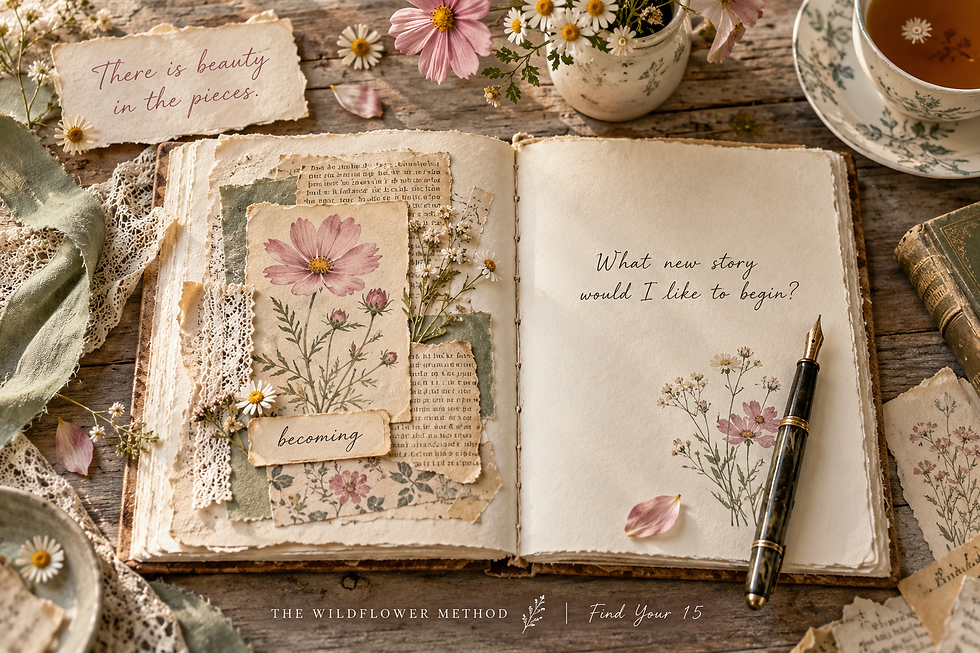
What new story would I like to begin?
Write beside your collage, across a lighter piece of paper or on a little card tucked into your journal.

Gather a few book pages, your journal and some glue.
Set aside 15 minutes to tear, arrange and create. You might begin with just three pieces and see where they lead.
Let this be a small pocket of time for curiosity.
When your 15 minutes are over, notice how you feel. You can stop there or keep creating if you have the time and desire.
One small piece is enough to begin.
This week’s creative challenge
Create one journal page using three different book-page pieces.
Add one word that reflects how you want to feel this week.
Before you close your journal, pause and notice one detail you love — an overlapping edge, a colour, a word or the way the pieces came together.
Your Wildflower Journey
LEARN — Explore Book Page Collage through Lesson #15.
CREATE — Try a page with permission to play.
COLLECT — Save the lesson with your growing Wildflower collection.
REFLECT — Choose a Soul Inquiry prompt and let your words follow.
SHARE — Share your page if you feel called to.
BLOOM — Carry your curiosity into your next small creation.
Visit the Wildflower Lesson Library to explore Lesson #15, then open your journal and
Find Your 15.
Your story is still growing. One little piece at a time. Continue creating with us
A little space to bloom
You don't need to be an artist.
You don't need hours of free time.
And you certainly don't need to have everything figured out.
Sometimes, all you need is 15 minutes, a little curiosity and permission to begin.
Your FREE Wildflower Starter Kit is a gentle invitation to slow down, reconnect with yourself and discover the joy of creating simply for you.
Download Your Free Wildflower Starter Kit
Your next chapter might begin with just 15 minutes.
Create from your heart. Inquire with your soul. Bloom wildly.



Comments